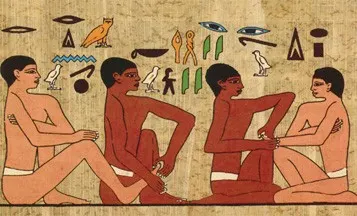
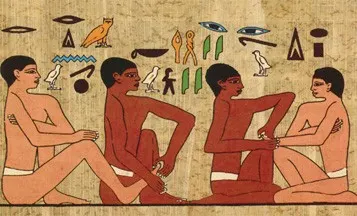
Four seated figures. Outstretched arms, bodies turned towards each other. Someone is working on another person’s hand; beside them, the attention is on a foot.
You may recognise the image: it often appears in articles about the history of massage. It made a brief appearance in our previous article. Now we will pause in front of it for a little longer. Are we really looking at massage?
What do we see and what do we add ourselves?
The treatment of hands and feet is clearly recognisable in the image. The precise movements and their purpose, however, are harder to establish.
As a massage therapist, I immediately think of touch and treatment. That is a natural association, but on its own it is not sufficient historical evidence. To understand the scene, we also need to examine its setting and the accompanying texts.
Wikimedia Commons categorises this image under manicure and pedicure. It is therefore worth looking at how researchers who studied the tomb more closely described the scene. [1]
Following a description more than a century old
In his archaeological publication of 1907, Jean Capart discussed the tomb’s scenes in detail. In the lower scene showing hand and foot treatments, he described nail care: a seated man’s toes are being treated, while another person’s hand is being cared for beside him.
Capart also translated the short dialogue accompanying the scene. In his interpretation, the man receiving treatment asks not to be hurt. The other man reassures him that he will proceed as the man wishes.
This suddenly brings the scene closer to us. It is easy to imagine the moment when someone entrusts a hand or foot to another person, while explaining what feels uncomfortable.
Here we retell the dialogue in our own words, based on Capart’s interpretation at the time. [2]
Why does the image’s setting matter?
Ankhmahor’s tomb dates from the sixth dynasty of Egypt’s Old Kingdom. Its surviving decoration includes inscriptions and scenes of human activities. A single isolated detail therefore tells us little about the whole. [3]
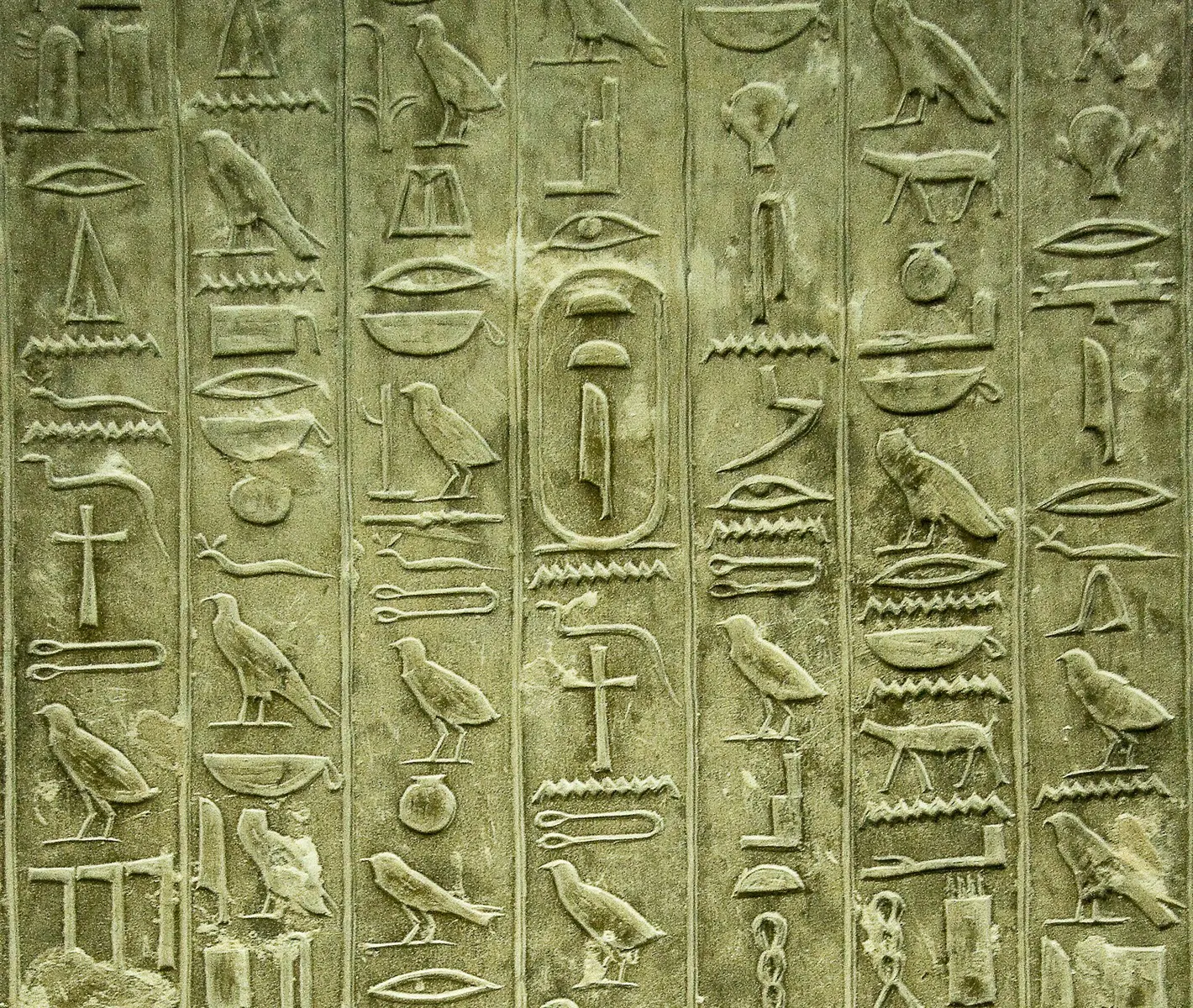
The inscriptions remind us that ancient images often come with written clues. Interpreting them requires expertise: a movement that looks familiar today may have a different meaning in its original setting.
What does this scene tell us?
The image alone does not allow us to establish that we are seeing massage or foot reflexology in their present-day sense. More evidence would be needed for that.
For me, its interest lies in the way it encourages us to look more carefully. At first, we think we recognise something; then, as we read the sources, new questions emerge. What exactly are these people doing? Why was this scene placed on the wall of the tomb? How much do we understand through our own experience, and what can we actually substantiate?
In the history of massage, I find these questions just as interesting as a date or a name.
In the next historical article, we will turn from images to written evidence. Our journey takes us to India, where we will explore how a later manuscript can preserve much older knowledge.