When I give a massage, I sometimes wonder: how did it all begin? Who first discovered that touching, rubbing or kneading with the hands could help another person?
It would be satisfying to name a single person or place. Yet the surviving evidence tells a much richer story. Massage was practised in many Eastern and Western cultures, so its beginnings are worth exploring in more than one place. [1]
Egypt: an image that raises questions
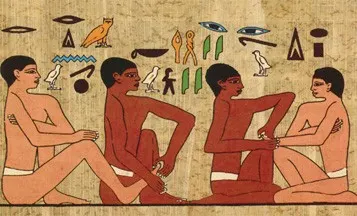
When reading about the history of massage, we often encounter a scene from Ankhmahor’s tomb at Saqqara. In the image, one person is working on another person’s hand; in another pair, the attention is on a foot.
At first glance, it would be easy to say: they were already giving massages!
But an ancient image cannot always be interpreted unambiguously through modern concepts. Wikimedia Commons categorises this scene under manicure and pedicure. I would therefore not regard the image alone as proof that it depicts massage or foot reflexology in their present-day sense. [2]
That is precisely what makes historical detective work so fascinating: what we can see and what we can establish with certainty are separate questions.
India: when texts tell the story
In India, written traditions offer important clues alongside images. Ayurvedic texts connect massage with caring for the body, and treatments using oil also have a place in this tradition. [3]
When looking at a surviving manuscript, however, we need to distinguish two different dates: when that particular copy was made and when the text it preserves took shape. A later copy can pass on much older knowledge.
The manuscript does not necessarily reveal the moment when a practice began. Instead, it offers a glimpse of how knowledge was preserved and handed down.
China: following the clues in a hand illustration
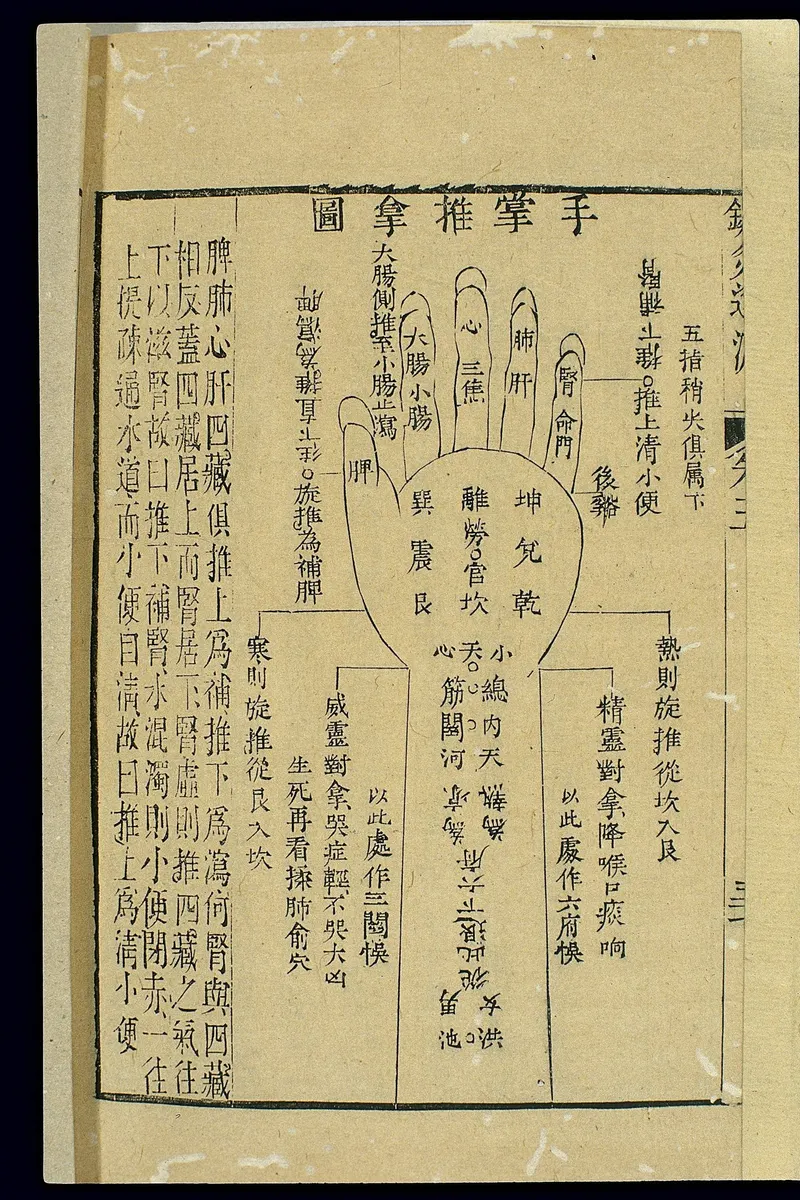
A particularly vivid example from the Chinese tradition is a tuina illustration in a book dated 1817. It shows a child’s palm and forearm and is accompanied by treatment instructions. It can still be viewed in the Wellcome Collection. [4]
This image deals specifically with hands-on treatment. Its date, however, belongs to the book being shown: it does not mean that the tradition itself began in 1817.
So who was first?
These sources do not allow us to name a single inventor. We encounter hands-on treatment of the body in different cultures, shaped by different ideas.
For me, that is what makes the history of massage so interesting. Every surviving image and text offers another opportunity to get closer to the lives of people in the past.
In the next historical article, we will take a closer look at the Egyptian scene showing hand and foot treatments. What does it tell us — and which questions remain open?